
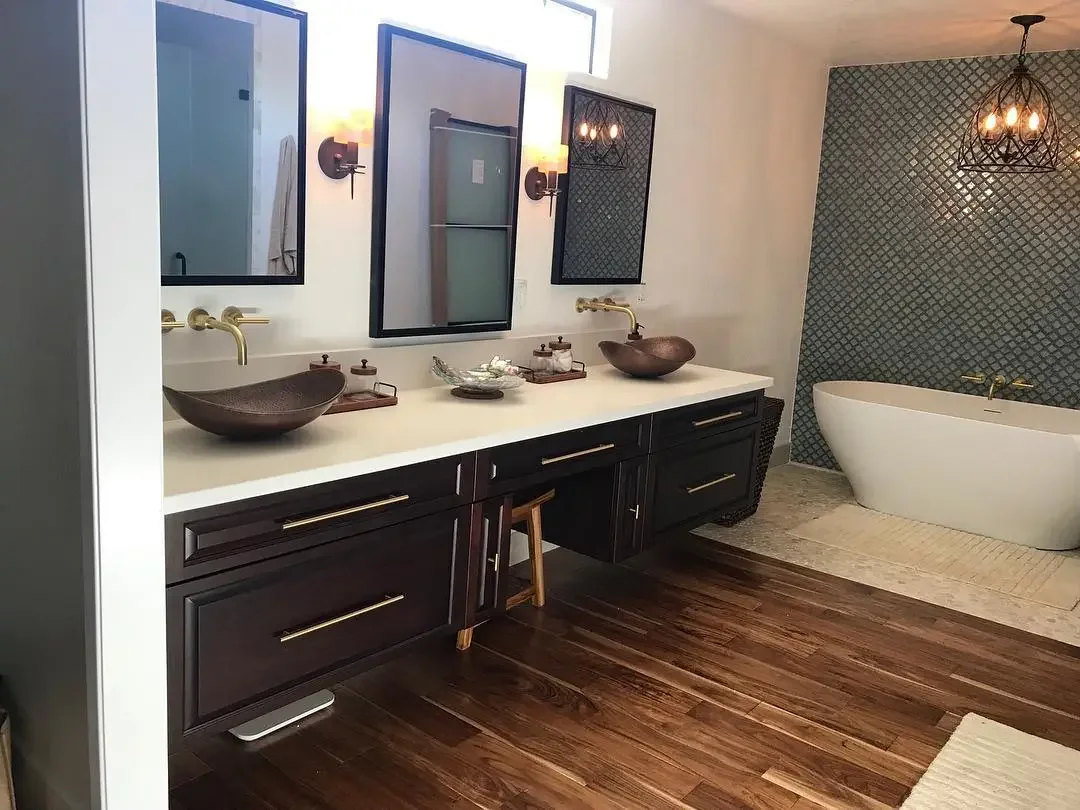
Quick answer: Ready-made bathroom vanity sizes follow a few common conventions. Single-sink vanities are typically sold in widths such as 24, 30, 36, 42 and 48 inches, and most double vanities measure 60 to 72 inches wide, with 84-inch and wider models for large primary bathrooms. The cabinet is usually about 21 inches deep, and the countertop overhang brings the finished depth to roughly 22 inches. Shallow models of 15 to 18 inches suit narrow rooms where a standard cabinet would crowd the walkway. These figures describe what manufacturers stock, and a custom vanity is instead sized to the wall, the sinks and the clearances around it.
Width and depth are only part of the plan. The National Kitchen & Bath Association's bathroom planning guidelines recommend clear floor space in front of the vanity and minimum distances from each sink to the nearest wall, and they cite the minimums of the International Residential Code alongside. Those distances often decide which width fits a room. Height is the third dimension, and it is covered in the guide to standard bathroom vanity height.
How Vanity Sizes Are Described
Bathroom vanity dimensions are usually given as width, depth and height, in that order, measured on the cabinet. The width runs along the wall, and the depth runs from the wall to the front of the cabinet. Both figures normally describe the cabinet box, and the countertop adds to them. A stone or quartz top usually overhangs the front of the cabinet, which is why a 21-inch cabinet produces a finished vanity close to 22 inches deep. Side overhangs depend on whether the vanity stands between two walls or has an exposed end.
Ready-made vanities come in fixed widths, so any gap between the cabinet and the walls is closed with filler strips or left open. A custom vanity starts from the finished room instead. The width is taken from the wall-to-wall measurement after tile or plaster, and the cabinet is scribed to walls that are rarely perfectly straight. The depth is chosen for the clearance in front of it, and the drawer layout is planned around the drain and supply lines.
Standard Bathroom Vanity Widths
The table summarizes the widths most commonly stocked and where each range tends to be used. The figures are conventions drawn from manufacturer ranges, and they overlap.
| Vanity type | Common widths | Typical rooms | Planning note |
|---|---|---|---|
| Compact single sink | 24 to 30 in. | Powder rooms and small guest bathrooms | Leaves little counter space beside the basin. A shallow cabinet often helps more than a narrower one. |
| Standard single sink | 36 to 48 in. | Guest and secondary bathrooms | Wide enough for a drawer bank beside the sink and usable counter space on both sides. |
| Compact double sink | About 48 in. | Shared bathrooms with limited wall length | Sink centers 30 in. apart. Each end needs open space or at least 6 in. clear to a wall to meet the code minimums. |
| Standard double sink | 60 to 72 in. | Primary bathrooms | Between two walls, these widths meet the code minimums. The recommended spacing needs a wall of at least 76 in. |
| Large double sink | 84 in. and wider | Large primary suites | Width beyond the recommended spacing, often used for storage between or beside the sinks. |
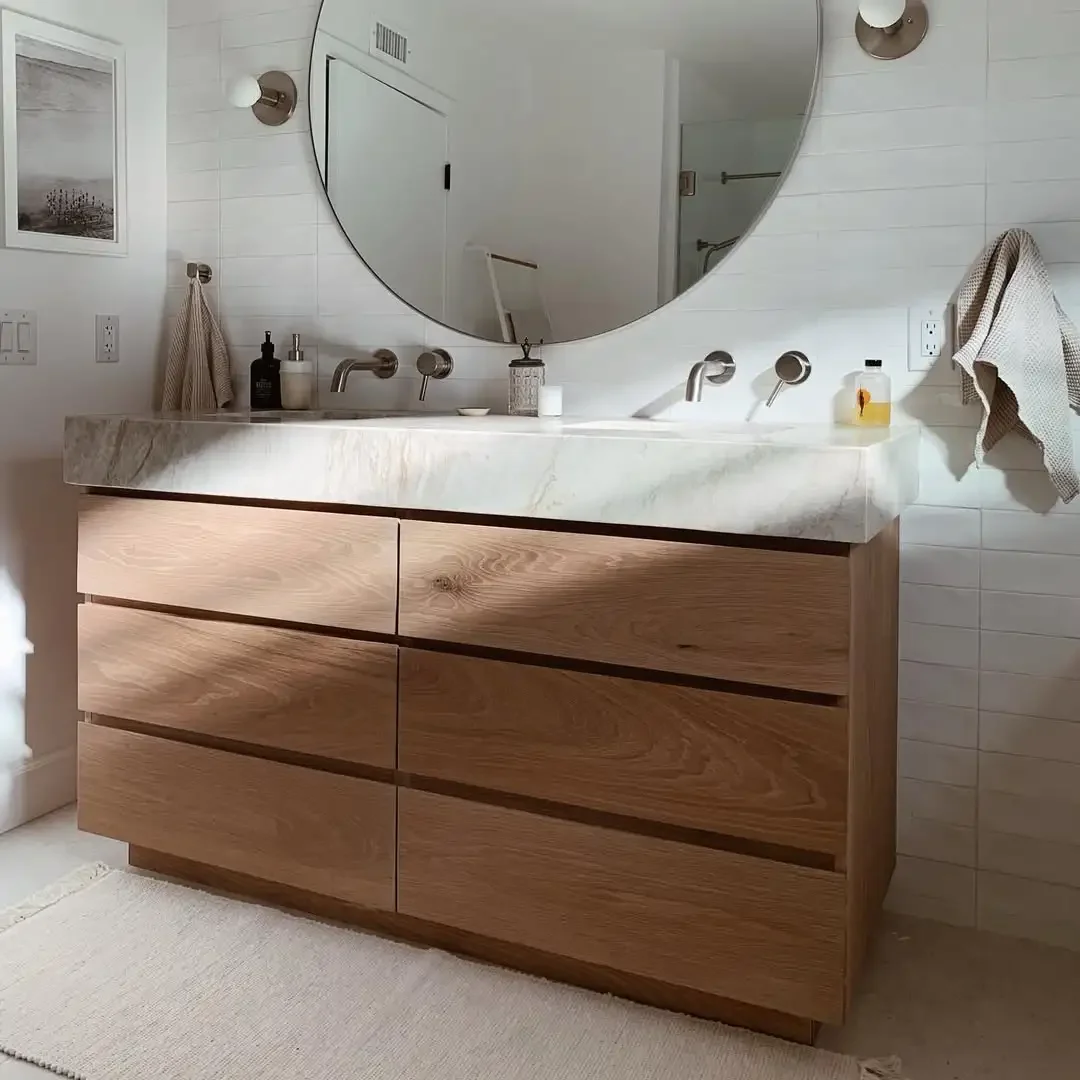
A single-sink vanity in the 36- to 48-inch range is a flexible choice for a secondary bathroom. The extra width goes to drawers rather than a second basin, which usually serves one or two regular users better. In a powder room the priorities reverse, because storage matters less than the walkway and the door swing. A compact vanity there is often a furniture-style or wall-hung piece chosen for its appearance as much as its capacity.
Standard Bathroom Vanity Depth
Most ready-made vanity cabinets are 21 inches deep, and the countertop brings the finished depth to about 22 inches. That depth leaves room for a standard undermount basin, the faucet behind it and a usable strip of counter. Shallow vanities between 15 and 18 inches are made for narrow bathrooms and powder rooms, where a full-depth cabinet would interrupt circulation. They usually pair with a smaller basin or a wall-mounted faucet to recover counter space. Deeper cabinets are sometimes specified for larger basins or extra storage, at the cost of floor space.
Depth matters most where the vanity faces another fixture or wall. The NKBA guidelines recommend at least 30 inches of clear floor space from the front edge of a fixture to anything opposite it, and they cite a code minimum of 21 inches. The guideline measures from the front edge of the fixture, so planning from the front edge of the countertop is the cautious approach. In a room where the vanity wall is 51 inches from a tub, a 21-inch cabinet with a 22-inch finished top leaves 29 inches, one inch short of the recommendation. Building the cabinet one inch shallower brings the clearance to 30 inches.
Double Vanity Dimensions and Sink Spacing
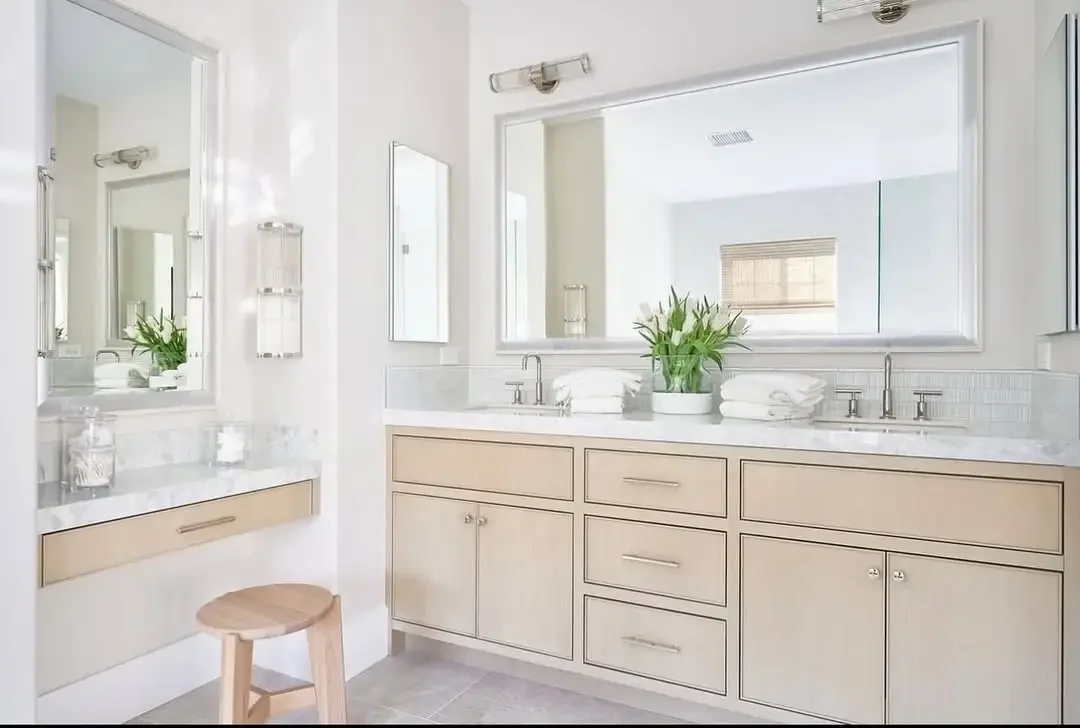
Most double vanities measure 60 to 72 inches wide, and larger primary bathrooms often take 84 inches or more. Some double vanities are also made in a compact 48-inch width for tight rooms. The limiting factor is the distance between the sinks and from each sink to the side walls. The NKBA guidelines recommend at least 36 inches between the centerlines of two sinks and cite a code minimum of 30 inches. They also recommend at least 20 inches from a sink's centerline to a side wall or tall obstacle, with a code minimum of 15 inches.
Those numbers set the shortest wall that a double vanity fits between. With both sinks at the recommended spacing, the wall needs to be at least 76 inches long, made up of 20 inches, 36 inches and 20 inches. At the code minimums of 15, 30 and 15 inches, the figure is 60 inches. A 48-inch double vanity with its sinks 30 inches apart leaves each sink centerline 9 inches from the end of the cabinet, so each end needs open space or at least 6 more inches of clearance to a wall to meet the code minimums. Any wall length beyond these figures adds width between or beside the sinks. Two separate single vanities on one wall follow the same spacing rules at each sink.
Clearances Around a Vanity
The planning distances in the NKBA guidelines, and the code minimums the guidelines cite, are summarized here.
| Measurement | NKBA recommendation | Code minimum cited |
|---|---|---|
| Clear floor space in front of the vanity | 30 in. | 21 in. |
| Sink centerline to a side wall or tall obstacle | 20 in. | 15 in. |
| Between the centerlines of two sinks | 36 in. | 30 in. |
| Edge of a freestanding or wall-hung sink to a wall | 4 in. | Not stated |
Electrical planning affects the cabinet as well. The code requirement cited in the NKBA guidelines calls for at least one ground-fault-protected receptacle within 36 inches of the outside edge of the sink. Where a wall location is not possible, the receptacle may be on the side or face of the vanity cabinet, no more than 12 inches below the top of the basin. These points summarize the guidelines and the code sections they cite, and local building codes govern any specific project.
Sizing a Vanity to the Room
The right vanity size comes from the room's finished dimensions, not the nearest standard width. The starting points are the wall length after tile, the distance to the fixture or wall opposite, and the swing of the bathroom door. The location of the toilet matters too, since its own clearance zone often limits how far the vanity can extend. The positions of windows, outlets and the existing drain also affect the width and the layout.
The room's use shapes the size as much as its dimensions. A powder room needs a vanity that leaves the walkway clear and looks finished from the doorway. A guest bathroom usually benefits from a single sink with generous drawers. A primary bathroom shared by two people is where a double vanity earns its width, provided the wall is long enough for the recommended sink spacing. Style decisions that follow from the size, such as a floating or furniture-style vanity, are covered in the collection of bathroom vanity ideas.
Frequently Asked Questions
What are the standard bathroom vanity sizes?
Ready-made single-sink vanities are commonly sold in widths such as 24, 30, 36, 42 and 48 inches, and most double vanities measure 60 to 72 inches wide. The cabinet is typically about 21 inches deep. These are manufacturer conventions, and a custom vanity can be built to any width the wall allows.
How deep is a standard bathroom vanity?
Most vanity cabinets are 21 inches deep, and the countertop overhang brings the finished depth to about 22 inches. Shallow vanities of 15 to 18 inches are made for narrow bathrooms and powder rooms.
What are standard double vanity dimensions?
Most double vanities are 60 to 72 inches wide, and large primary bathrooms often take 84 inches or more. A double vanity between two walls needs a wall of at least 60 inches to meet the code minimums cited by the NKBA, and 76 inches to meet its recommended spacing.
How far apart should two bathroom sinks be?
The NKBA guidelines recommend at least 36 inches between the centerlines of two sinks, and they cite a code minimum of 30 inches. Each sink's centerline should also be at least 20 inches from a side wall or tall obstacle, with a code minimum of 15 inches.
Custom Vanities Sized to the Room
Knotty Nuff Wood builds custom bathroom vanities to the measurements of each room, as part of its custom cabinetry work for homes in Orange County and Los Angeles County. A custom vanity takes its width from the finished wall and its depth from the clearance in front of it, so the standard sizes serve as reference points rather than limits.
Ready to plan a vanity sized to your bathroom? Contact Knotty Nuff Wood for custom vanity solutions tailored to your home.